Blockchain Demo
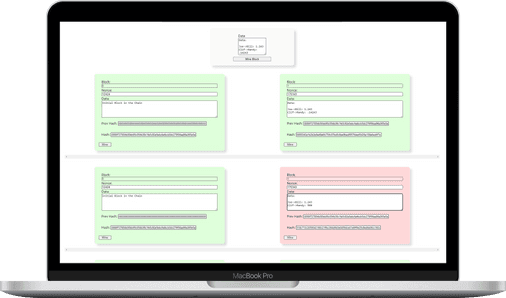
A visual walkthrough of blockchain technologies. Learn about key concepts like hash functions, blocks, blockchains, and distributed ledger technologies.
Thu Nov 18 2021
Live DemoBlockchain Demo
Welcome to my Blockchain Demo project! This educational tool provides a hands-on way to learn the core concepts behind blockchain technologies. Whether you’re new to the blockchain world or brushing up on your knowledge, this demo walks you through the foundational ideas: hash functions, blocks, and distributed ledgers.
I've built this site using ReactJS and created a pseudo-blockchain engine to drive the interactive elements. You can see and interact with blockchain mechanics in real-time, such as mining blocks, validating hashes, and adding new blocks.
Inspired by the great work and videos done by Anders Brownworth
How it Works
At its core, this project implements a simplified version of a blockchain, demonstrating basic methods you'd find in real-world blockchains: validating hashes, mining blocks, and adding new ones to the chain. The goal is to make complex blockchain ideas more tangible and easy to understand.
Here’s a quick breakdown of the blockchain class:
Key Features of the Blockchain Class
- Genesis Block Creation: The first block in the chain, with a predefined hash and data.
- Hash Calculation: The project uses
SHA256to calculate hashes based on block data, index, and the previous block's hash. - Block Validation: It ensures the difficulty level is met by checking that the calculated hash has a sufficient number of leading zeros.
- Mining Blocks: This feature involves repeatedly calculating a hash until the desired difficulty is achieved, demonstrating the proof-of-work concept.
- Dynamic Block Updates: Users can interact with blocks, modify their data, and see how this affects the blockchain's integrity.
Below is the source code that powers the blockchain functionality:
export class Blockchain {
constructor() {
this.chain = [this.initGenesisBlock()];
this.difficulty = 4;
}
initGenesisBlock() {
let prevHash = "0000000000000000000000000000000000000000000000000000000000000000";
let data = "Initial Block in the Chain";
let firstBlock = new Block(
prevHash,
0,
data,
"0000f727854b50bb95c054b39c1fe5c92e5ebcfa4bcb5dc279f56aa96a365e5a"
);
firstBlock.nonce = 12424;
return firstBlock;
}
calculateHash(block, testNonce) {
return SHA256(
testNonce + block.data + block.index + block.prevHash
).toString();
}
validateHash = (block) => {
return (
this.calculateHash(block, block.nonce).substring(0, this.difficulty) !==
Array(this.difficulty + 1).join("0")
);
};
updateChain(block) {
// Updates hash and validates new blocks in the chain
for (let i = block.index + 1; i < this.chain.length; i++) {
this.chain[i].prevHash = this.chain[i - 1].hash;
this.chain[i].hash = this.calculateHash(this.chain[i], this.chain[i].nonce);
this.chain[i].error = this.validateHash(this.chain);
}
}
latestBlock() {
return this.chain[this.chain.length - 1];
}
mineBlock(block, isChain) {
if (this.validateHash(block, block.nonce)) {
let testNonce = 0;
while (
this.calculateHash(block, testNonce).substring(0, this.difficulty) !==
Array(this.difficulty + 1).join("0")
) {
testNonce++;
}
this.chain[block.index].nonce = testNonce;
this.chain[block.index].hash = this.calculateHash(block, testNonce);
this.chain[block.index].error = this.validateHash(block);
if (isChain) {
this.updateChain(block);
}
return this.chain;
} else {
block.error = false;
return⬤
}